


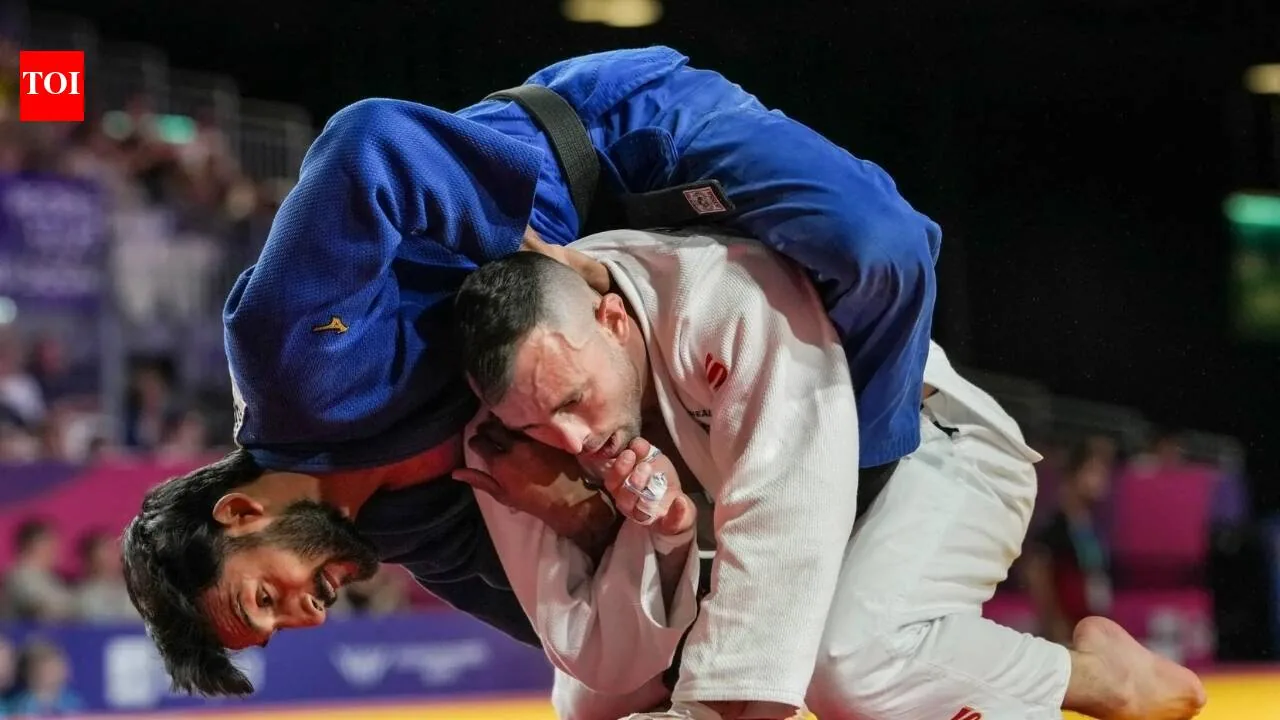
Indian Judokas Secure Finals Berths
India has secured at least three silver medals in judo at the Commonwealth Games in Glasgow, with Asmita Dey, Harsh Singh, and Yamini Mourya each advancing to the finals in their respective weight categories. The trio’s strong performances on Friday guarantee India a significant presence on the judo podium.
Asmita Dey demonstrated a notable comeback in the women’s 48kg semifinal. She overcame Scotland’s Summer Shaw by yuko, securing her spot in the final. Dey is scheduled to compete against Canada’s Heidi Quach later on Friday for the gold medal. Her path to the semifinal included an earlier victory over Scotland’s Eva Ewing, which she achieved with an ippon.
An ippon represents the highest possible score in judo, leading to an immediate end to the match. A yuko, while a lower-level score, was reinstated by the International Judo Federation (IJF) for the Los Angeles 2028 Olympic cycle.
Harsh Singh and Yamini Mourya Advance
Harsh Singh also made his way to the men’s 60kg final. He defeated Australia’s Pedro Carlos Antun Neto in the semifinal with a waza-ari. Singh’s journey to the final included an ippon win against Malawi’s Chikondi Kathewera in the opening round, followed by a victory over Vanuatu’s Alan Monthouel in the quarterfinals. He is set to face Australia’s Joshua Katz in the final later on Friday.
A waza-ari is the second-highest score in judo, providing a significant advantage. This score is awarded for a throw that lacks one element required for an ippon, or for a ground hold maintained for a duration of 10 to 19 seconds. Accumulating two waza-aris is equivalent to one ippon, which concludes the contest.
Yamini Mourya also secured a place in a women’s final, triumphing over South Africa’s Donne Breytenbach with an ippon in her semifinal bout. Mourya will compete against England’s Acelya Toprak in the title match. Earlier in the competition, Yamini had defeated Ghana’s Frema Agyei to reach the semifinals.
Other Indian Judokas’ Performances
While three Indian judokas advanced to the finals, others faced challenges in their respective categories. In the women’s 52kg category, Shraddha Kadubal Chopade was unable to secure a medal. She lost to Wales’ Lola Hodson by yuko in the repechage round. Chopade had commenced her campaign with an ippon victory against Sierra Leone’s Jane Massaquoi before experiencing a loss to Australia’s Tinka Easton.
Similarly, in the men’s 66kg category, Rohit Basir Majgul was eliminated in the repechage. He was defeated by England’s Michael Fryer by yuko. Majgul had previously beaten Mozambique’s Samuel Ribeiro but then suffered a quarterfinal defeat to Cyprus’ Petros Christodoulides.
Decathlon Update
In other Commonwealth Games action, Tejaswin Shankar made a strong start in the pole vault event as part of the decathlon. He successfully cleared 4.10m on his first attempt, adding 645 points to his decathlon total. Shankar navigated his initial height comfortably, though the competition at the top remains close.
Canada’s Damian Warner, the defending champion, cleared 4.40m on his first attempt with apparent ease. However, Warner encountered some misfortune on his subsequent attempt; he cleared the height, but his pole dislodged the bar on the way down, resulting in a red flag. The overall standings in the decathlon remain tightly contested:
- Damian Warner – 6,669 points
- Sammy Ball – 6,620 points
- Lindon Victor – 6,616 points
- Tejaswin Shankar – 6,580 points
With further jumps still to come in the pole vault, Tejaswin Shankar remains a strong contender in what is proving to be a competitive decathlon event.
Source: m.rediff.com