


The 23rd Commonwealth Games have commenced in Glasgow with an opening ceremony at the OVO Hydro, blending Scottish heritage with contemporary performances. The event, which saw King Charles III declare the Games open, emphasized sustainability and celebrated Glasgow’s cultural identity as a UNESCO City of Music.
The ceremony marked a departure from traditional open-air stadium shows, taking place entirely within the 14,300-capacity indoor venue. Athletes from the 74 participating nations paraded into the arena at the beginning of the show, a first for the Commonwealth Games. The Indian contingent, led by Olympic medallists Mirabai Chanu and Lovlina Borgohain, received a warm reception.
The King’s Baton, which had travelled through all 74 Commonwealth member nations during a 500-day global relay, contained a message from King Charles III. He highlighted the importance of connecting for a common future and urged efforts to address plastic pollution in oceans and waterways, emphasizing its impact on human health and the need to protect marine ecosystems.
Sporting Action Begins
Early sporting events have already provided memorable moments. In para powerlifting, England’s Mark Swan secured the first gold medal of the Games. Swan, who bench-pressed 222kg, initially expressed confusion as he had the same score as Nigeria’s Roland Ezuruike. Officials later clarified that a second decimal point separated their scores.
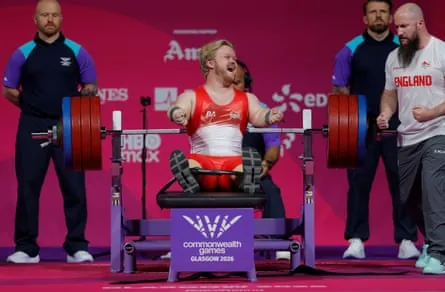
Swan’s journey in powerlifting began at an event for the Dwarf Sports Association Games, where he lifted 70kg to earn a bronze medal. His gold medal win was met with cheers from a crowd at the Armadillo Arena, partly filled by members of the Tartan Army who received free tickets to certain events.
At the Tollcross International Swimming Centre, a brief delay occurred during the 100m breaststroke heats when a volunteer had to fix a broken rope underwater. The crowd applauded the volunteer’s quick action, allowing double Olympic champion Adam Ramsay-Peaty to continue his race.
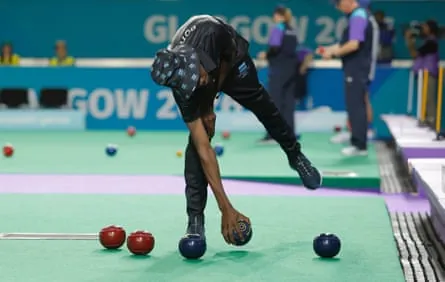
In lawn bowls, Botswana’s Diza Mphotho captivated the audience at the indoor SEC arena with his distinctive bucket hat and playing style, despite a loss to Guernsey’s Jason Greenslade. Mphotho, an IT worker, shared that he uses his annual leave to participate in the Games, calling the experience “completely worth it.”
A Reimagined Games Model
The Glasgow 2026 Games represent a scaled-down model compared to previous editions, following Victoria’s withdrawal in 2023 due to projected costs. Glasgow stepped in as host, adopting a compact, lower-cost structure with 10 sports and six integrated Para sports, making it the largest integrated Para sport program in Commonwealth Games history.
The events are being held across four existing venues: Scotstoun Stadium, the Scottish Event Campus, Glasgow International Arena, and Tollcross International Swimming Centre. Glasgow 2026 Chair George Black highlighted the city’s crucial role in preserving the international multi-sport event.
Despite some initial challenges, including a noticeable number of empty seats and higher accommodation prices for visitors, organizers maintain that momentum is building. Phil Batty, chief executive of Glasgow 2026, noted that facilities like the velodrome are sold out and that more tickets have been sold for netball than ever before in Scotland’s history. The opening day showcased that the reimagined Games, though smaller, retain significant soul and glow.
The Commonwealth flag was raised at the centre of the stage, with Scotland’s lawn ball player Paul Foster, 3×3 basketball player Robyn Love, and Leslie Roy reading the oath.
Source: theguardian.com