



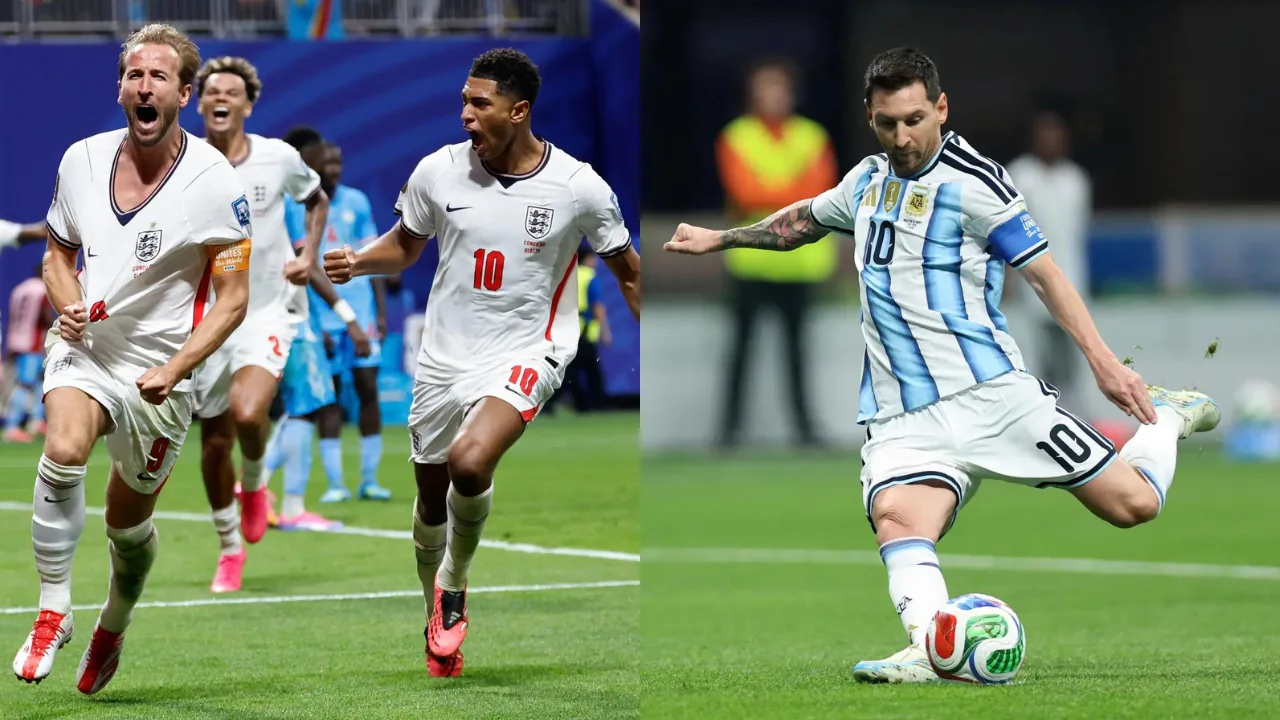
Argentina could face a fine from FIFA after players displayed a banner supporting their country’s claim to the Falkland Islands following their World Cup semi-final victory against England. The defending world champions secured a dramatic 2-1 comeback win against Thomas Tuchel‘s side in Atlanta, booking their place in the final against Spain.
After the final whistle, Argentina players were observed celebrating with a banner that read “Las Malvinas son Argentinas,” which translates to “The Falklands are Argentine.” This action could lead to sanctions from football’s governing body, as FIFA has previously fined the Argentine Football Association for similar displays.
Historical Context of the Rivalry
The display of the banner highlights the long-standing political tensions between the United Kingdom and Argentina regarding the Falkland Islands. The archipelago, located approximately 300 miles off Argentina‘s east coast, has been a British Overseas Territory since 1833. A conflict over the islands occurred from April to June 1982, lasting 74 days. This war resulted in the deaths of 655 Argentine and 255 British servicemen, in addition to three islanders.
Argentina maintains that the islands should be under its sovereignty. The rivalry between the two nations extends across generations, encompassing football, history, politics, and colonialism. This deep-seated sentiment is often reflected in football chants and celebrations.
In 2014, the Argentine Football Association was fined £20,000 by FIFA after its players held up a banner with the identical message before a friendly match against Slovenia. FIFA stated at the time that such gestures violated rules concerning political action and team misconduct.
Manager’s Stance and Vice-President’s Comments
Prior to the semi-final match, Argentina manager Lionel Scaloni had expressed his intention not to mix football with politics. He stated that the reality of the situation was a football match and that he could not combine the two, particularly out of respect for historical events.
Scaloni acknowledged the sadness of the period in history and noted that little could be done about it. He also mentioned that current global events involving war are criticised, and the people involved in past conflicts are remembered. However, he reiterated that the match was a football game and the two should not be confused.
Despite Scaloni‘s comments, Argentina vice-president Victoria Villarruel referenced a chant sung by the players after their 3-2 victory over Egypt in the last 16. This chant made reference to the Falklands, as well as Argentina football legends Diego Maradona and Lionel Messi.
Villarruel posted on social media, stating that the match was more than just another game, especially against the English. She linked it to the Malvinas, Diego, and Leo‘s final tournament, emphasising the desire to “put the invaders in their place.” Her post concluded with “Long live Argentina! Because until our very last breath, we will reclaim what is ours!”
The semi-final match itself, which England lost due to late goals from Enzo Fernandez and Lautaro Martinez, was played under heightened security measures. These measures were implemented due to the historical tensions that exist between the two nations.
The Enduring Rivalry on the Pitch
The football rivalry between Argentina and England is one of international football’s most intense, marked by decades of bitterness where history and sport frequently intertwine. The first World Cup encounter between the two nations took place in 1962, but the rivalry truly escalated four years later.
A common chant among Argentina‘s football fans and players, regardless of the opposition, is “Y ya lo ve, y ya lo ve. El que no salta, Es un ingles!” which translates to “And now you see, and now you see, whoever doesn’t jump is English.” This slogan has become an integral part of Argentina‘s football identity, sung by supporters from the stands and joined in by players after victories.
The rivalry intensified in the 1966 World Cup quarter-final, a match still remembered in Argentina with claims of a controversial winning goal by Geoff Hurst. The game also saw Argentina captain Antonio Rattin sent off, leading to an almost eight-minute delay as he refused to leave the field. Following the match, England manager Alf Ramsey controversially described Argentina as “animals.” This particular match contributed to the later introduction of yellow and red cards in football.
The 1986 World Cup quarter-final, played four years after the Falklands War, is considered a defining chapter of the rivalry. In this match, Diego Maradona scored both the infamous “Hand of God” goal and the “Goal of the Century” within four minutes. Argentina ultimately went on to win the World Cup that year.
Subsequent encounters have also been memorable, including the 1998 World Cup Round of 16 match where David Beckham received a red card. Argentina advanced after winning a penalty shootout in that game. In 2002, England secured a 1-0 victory with Beckham converting a penalty.
The recent semi-final marked Lionel Messi‘s first match against England in his extensive international career, a fixture the Argentine Football Association described as “the match fate owed Messi.”
Read Also
- England faces Argentina in World Cup semi-final with minimal injury concerns
- Atlanta: England prepare for World Cup semi-final against Argentina, pressure on reigning champions
- Oslo: Erling Haaland returns from World Cup with unique souvenirs
- FIFA defends semifinal referee after France's Deschamps questions officiating
Source: bbc.com